





If 2025 was the year of moving from legacy web portals to simple doorways to bustling digital hubs, then 2026 is about enhancing these modern solutions. These robust ecosystems are about making communication smooth, putting operations on autopilot, and customizing things to match your business use case.
Whether it’s a portal for your customers, your partners, or even your own team, businesses everywhere are constantly looking for ways to improve and expand their capabilities. The goal for everyone is the same, to streamline their processes in the current ever-evolving digital ecosystem.
But here’s the thing: just like everything else, what we expect from these portals keeps changing. Nowadays, whether you’re an external client or an internal employee, you’re looking for things to be easy, self-service, and smart. That’s why having the right bells and whistles isn’t just a nice-to-have anymore; it’s a must.
Let’s jump right into the custom web portal features 2026 that are no longer a luxury but a must-have.
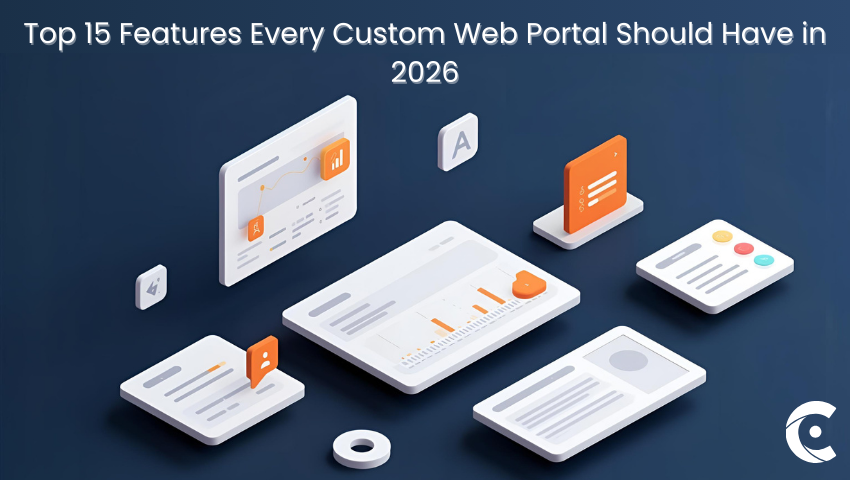
Top 15 Web Portal Features You Absolutely Need in 2026
As our digital world gets more intricate, we’re all expecting web portals to be smarter, faster, and just plain easier to use. Whether you’re building a portal from the ground up or just trying to make your current one better, these are the custom web portal features that 2026 has made totally essential for giving users real value and keeping your business on track.
Think of these as the non-negotiables features of a modern web portal:
1. Role-Based Access Control & Redirection: Your admins get to set specific permissions based on whether the user is a customer, partner or an employee to ensure data integrity and mitigate user confusion post login. The sophisticated system automatically redirects to their dedicated dashboard or relevant landing page.
This ensures users get only selective access to the dashboard (they see only the information relevant to them). While the data integrity is maintained across multiple roles in the organization.
2. Smart Search Functionality: As portals get packed with more and more stuff, users need to be able to find what they’re looking for without pulling their hair out. Advanced search with smart filters, keyword tags, and even suggestions that pop up as you type can seriously improve navigation and make things way less frustrating.
This will significantly reduce manual search effort and further streamline processes. This way, you can upscale your business without worrying about the data management issues.
3. AI That Does the Heavy Lifting: One of the coolest things about modern web portals is how smart they’re getting. Suggesting what content might be helpful, AI is making the user journey smoother, cutting down on those repetitive tasks, and helping you make decisions faster.
AI streamlines the transformation journey and makes adopting a new system easier. Not just that, given its advanced capabilities, it is always a good addition, especially if you have a multi-layer complex management system.
4. Self-Service Capabilities: Nobody wants to wait for support if they can handle something themselves. Whether it’s resetting a password, downloading a document, or submitting a request, letting users do it on their own saves everyone time and cuts down on support costs.
This is what a well-designed custom web portal can deliver to your team – reduced support calls, better & focused services, and easier process management.
5. Seamless Configuration Migration: You can now easily migrate configurations like pages, user roles, and workflows between sandbox and production environments. Role-based access controls ensure data security while significantly simplifying the process for development teams.
The feature creates a secure migration environment for information import and export without requiring manual configuration rebuilds or dealing with environmental inconsistencies. Thus, your team enjoys a simplified migration of the development workflow while ensuring consistent deployments.
6. Keeping Your Documents Safe and Shareable: A good file management system lets users easily upload, store, and share documents while making sure the right version is always there and only the right people have access.
If you’re in industries like finance, education, or healthcare, this is absolutely crucial. Given the increasing complexity of the digital world, role-based access controls are important for maintaining data integrity, security, and a secure, shareable environment.
7. Third-Party Integrations: One of the hallmarks of a truly useful web portal in 20265 is how well it plays with others. Your portal should seamlessly connect with your CRM, support tools, marketing platforms, and payment systems.
This means everything works together smoothly, and you don’t have information stuck in different silos. Make sure that whatever option you choose works seamlessly with your digital infrastructure to avoid information gaps and roadblocks.
8. Multilingual and Multi-Currency Support: If you’ve got a global audience, you need to speak their language – literally. Supporting multiple languages and currencies makes your portal feel more welcoming and helps businesses reach more people while keeping all the financial details accurate.
This adds a local touch to your global business that resonates with the audience of that particular area. People feel more connected to your organization and processes.
9. Analytics and Reporting Modules: To make smart decisions, you need to see what’s going on. Built-in analytics tools help both regular users and administrators track how things are performing.
You get accurate insights into how the portal is being used and what the trends are – whether it’s sales numbers, support requests, or engagement levels and you get to see all this right from the portal itself.
10. Real-Time Notifications: Nobody wants to miss important updates. Real-time alerts for things like changes or reminders keep everyone connected and informed. Whether it’s an update on a support ticket or a notification about a deadline, these timely alerts help people respond quickly and stay engaged.
One way to achieve this is by connecting your CRM with external and internal workflows. This enhances information transformation, which, in turn, helps your team receive updates in real time throughout the process lifecycle.
11. Customizable Forms and Workflows: Let’s be honest, no two businesses do things exactly the same way. Customizable forms and workflows let you tailor the portal to your specific business processes, automating tasks like bringing new people on board, getting approvals, handling service requests, and a whole lot more.
So choose the portal that offers ample flexibility. A solution that aligns with your workflow, rather than the other way round, is what we call a perfect solution. These digital solutions are designed to enhance the efficiency of your digital infrastructure.
12. Robust Security and Transparency: When it comes to your data, security is paramount, and that’s what a portal should offer. Your admin should be able to track and audit every portal user’s actions from a centralized admin panel. Auto-capturing of every action from login to document access gives clear visibility into what exactly is happening in the system.
And, if the entire log is searchable, it is an added bonus. It will allows your admin team to pull out the required data as and when needed which helps with quick insights and builds reports in minutes. It is also beneficial for admins who need immediate access to user activity records without digging through multiple systems.
13. Multi-Domain Portal: Expand your business across multiple regions and engage with different brands without the need to use separate platforms for all of them. You can centralize multiple brands and partners with a single portal that supports multiple brand sites.
The best part is that each site will be independent of the others in terms of content, domain, and access rules. So you can easily maintain separate brand experiences for different partners, offer them localized content without increasing administrative overhead.
14. Global Filter Across Dashboard Widgets: Global filter syncs the data across all the connected components, including lists, charts, and KPIs. It thus gives a unified data view across multiple dashboards. This mitigates the process of adding multiple filters just to check one report, thus making data analysis faster and more efficient.
It will let you get complete information across all the charts and consolidate them with a single filter. This ensures consistent data views without requiring manual adjustments and accelerates decision-making.
15. Custom Widget Builder: If standard widgets are not your style and you want something that is tailored to your business or industry requirements, then the custom widget builder is a must. It would be even better if it supports widget building using HTML or CSS, or JavaScript, along with the CRM data.
Another excellent addition here would be to have multilingual support and flexible UI enhancements without the need for full development cycles. This helps with unique data visualization, industry-tailored dashboard designs, and custom workflow interfaces.
What’s Making These Features So Demanding in 2026?
The must-have web portal features are being shaped by some key trends that really focus on giving users more power, keeping things secure, and making everything more efficient.
Let’s take a look at what’s pushing these essential features to the front of the line:
AI is Here to Stay
Artificial Intelligence isn’t just a techy buzzword anymore – it’s woven into the fabric of our everyday tools. From those helpful auto-suggestions you see to systems that automate tasks for you, people expect technology to “know” what they need, sometimes even before they ask. This is why we’re seeing a big push for AI-powered dashboards, chatbots that can answer questions instantly, and recommendation engines within modern portals.
User-Centric Design is King
In 2026, if something isn’t easy to use, it’s a no-go. Whether it’s a customer tracking their delivery or an employee looking up a company policy, the experience needs to be smooth and intuitive. This is driving the demand for personalized interfaces that feel just right, portals that work perfectly on your phone, and navigation that just makes sense – all core features of a modern web portal.
Keeping Your Data Safe is a Top Priority
With all the complex rules and regulations around data privacy, companies are under a lot of pressure to lock down how data is accessed, stored, and used. Secure login systems, making sure only the right people can see certain things, and keeping a record of who did what are now basic requirements for any web portal.
The World is Getting Smaller
Businesses are reaching across borders , and that means dealing with different languages, cultures, and currencies. Supporting multiple languages and currencies isn’t just a nice extra anymore; it can be a deal-breaker for companies looking to grow globally. Portals need to adapt to serve a diverse range of users without causing any headaches.
We Need to Work Together
Workforces are more spread out than ever, and customers expect faster service. Partners need quick access to information. All of this puts collaboration tools – like chat features, comment sections, ticketing systems, and forums – in the spotlight, making them essential for effective communication and engagement.
API-First, Integration-Ready Platforms
As our digital toolkits grow, businesses want all their tools to work together seamlessly. Whether it’s connecting to their CRM, pulling data from an ERP system, or adding a support widget, modern portals need to integrate easily – supporting the idea of building something once and scaling it endlessly.
Demand for On-Demand Support and Self-Service
Customers today don’t want to wait on hold. They prefer portals that let them get what they need on their own – whether it’s downloading a document, checking the status of something, or making a payment – without having to reach out for help. This trend continues to make self-service a major priority over traditional support channels.
These trends make one thing crystal clear: the expectations for web portal experiences are only going up, and the businesses that can meet and exceed these expectations will be the ones that build stronger customer loyalty and operate most efficiently.
How CRMJetty Helps You Nail Modern Web Portal Expectations
CRMJetty is all about building custom web portals that fit your unique business like a glove – while also ensuring you have every must-have modern feature. Whether you’re looking after customers, partners, employees, or even students, our portal solutions are built to be secure, scalable, and easy to use.
Here’s a peek at how CRMJetty delivers on those essential web portal features for 2026:
✅ Experiences That Feel Like They Were Made Just for You: With dashboards that change based on who’s logged in, content that’s tailored to what you need, and layouts that adapt, every user gets a view that just works for them – making them more engaged from the very first click.
✅ Everything Talking to Each Other Right Out of the Box: We’ve got ready-made connections for popular platforms like Salesforce, Dynamics 365, and WordPress. Our “connect everything” approach ensures that data flows smoothly and everything works together.
✅ Looks Great on Any Screen, Big or Small: Every portal we build is designed to look and work perfectly whether you’re on a computer, a tablet, or your phone. Your users will get a smooth, easy-to-use experience no matter how they log in.
✅ Empowering Users to Help Themselves: CRMJetty portals are designed to cut down on the need for constant support. With easy access to knowledge bases, simple ways to submit forms, tools for tracking progress, and real-time communication, users can usually find what they need and take action on their own.
✅ Built to Grow (Safely!): With strong user authentication, security measures like SSL, controls over who can see what, and frameworks that help with compliance, our portals are not only secure but also built to handle whatever growth your business throws their way.
✅ Customization Without the Headache: We get that every business is different. That’s why our portals are built like building blocks – you get exactly what you need without making things complicated to use or maintain.
With all these capabilities, CRMJetty offers a portal packed that is not only packed with with features but also actually works great in the real world. Our focus is on giving you solutions that not only meet all the demands of web portal functionality 20265 but also keep evolving right alongside your business.
So, if you’re thinking about building a portal or giving your current one a serious makeover, CRMJetty is here to lend a hand. With years of experience under our belts and a focus on being flexible, we offer custom web portal solutions that will fit your business processes and goals like a glove.
Ready to make sure your online presence is ready for the future?
Reach out to CRMJetty today, and let’s chat about how we can build a modern, feature-packed portal that’s perfectly tailored to what you need.
All product and company names are trademarks™, registered® or copyright© trademarks of their respective holders. Use of them does not imply any affiliation with or endorsement by them.