









Customer service is entering its most transformative era. Something big is happening, and no, this is not about another chatbot upgrade or a fancier ticketing system.
The shift happening right now is structural. The kind of change that separates companies that thrive from those scrambling to catch up. Big brands like Apple, Amazon, and Netflix are setting the expectations higher than ever with their seamless support, predictive analysis, and exceptional experiences.
This is leading the transformative shift in customer expectations, which, if brands are not able to figure out how to reach. It is creating a massive gap between what customers seek and what businesses offer.
Here’s where the gaps are visible:
Email queues that need 24 – 48 hours instead of providing immediate assistance. Phone trees where customers repeat their problem multiple times which is exhausting. Chatbots that respond “I didn’t quite catch that” to straightforward questions and CRM data that is locked away from the customers, who actually need it for proper visibility.
But by 2026, these rules will change completely. AI will stop being a novelty and become infrastructure. Self-service customer portals are emerging as primary touchpoints, not just backup channels. Predictive service will shift from “nice to have” to “table stakes.” Privacy regulations get teeth. And here’s the kicker: customer experience transformation lands on CEO agendas, not buried in operations meetings.
What actually works in this new world? Portal-based ecosystems built for Salesforce and Dynamics 365. Systems delivering self-service customer portals with smart knowledge access, unified case management, live CRM integration, and automation baked in.
You need that digital experience layer sitting on top of your CRM. It is the connecting piece that makes everything customer-facing actually work at scale. So, let’s break down the ten shifts defining 2026.

Transformation #1: AI Agents Become the First Line of Support
Chatbots had their moment. They answered FAQs, deflected basic queries, and saved some agent time. Useful enough. AI agents in 2026 will be completely different.
These systems can handle 60-80% of routine issues and they don’t just talk. They are capable of doing all this:
- Create support tickets with proper categorization
- Process refunds for qualifying cases without human sign-off
- Update customer records in real-time
- Validate uploaded documents automatically
- Trigger backend workflows based on conversation context
- Recommend solutions pulled from historical resolution data
The distinction matters. Response-driven bots answer questions. Action-driven agents complete tasks.
But for this to work, you need a portal to connect with your CRM workflow. Your customers see and interact with the portal, which serves as the interface they use to search and submit queries/complaints. Your CRM stores real data and runs workflows behind the scenes.
When both connect, AI offers smart recommendations, auto-routed tickets, and resolves issues without human involvement. Disconnect them, and AI has nothing to work with.
Transformation #2: Self-Service Customer Portals Become the Core of Customer Support
Customers increasingly prefer portals over talking to humans for most service interactions. Not because they dislike people. Because they dislike waiting and repeating themselves. Dislike working around someone else’s schedule.
A well-designed self-service customer portals deliver what customers actually want:
- Track issue status without calling for updates
- Submit requests at 2 AM if that’s when they have time
- View complete order histories going back years
- Update addresses, payment methods, and preferences instantly
- Download invoices without asking anyone
- Access product documentation organized by their specific purchases
- Manage subscriptions—upgrades, downgrades, cancellations—independently
Organizations running unified, login-based self-service environments with deep Salesforce customer portal or Dynamics 365 customer portal integration observe that most of their queries are resolved without agent involvement. Every action syncs to CRM. Every interaction updates records. Portal experiences adapt based on customer type, account tier, and product ownership.
The operational math gets compelling fast. Shifting call center traffic to a self-service customer portal isn’t an incremental improvement—it rewrites your cost structure entirely.
Transformation #3: Predictive Customer Service Replaces Reactive Support
Reactive support sits around waiting for problems. Predictive service spots trouble before customers notice anything wrong.
Real examples making this concrete:
- Predicting hardware failure from usage patterns and reaching out before the breakdown
- Detecting churn risk signals and intervening with retention offers proactively
- Surfacing solutions based on what similar customers needed at this stage
- Anticipating delivery delays and communicating alternatives before frustrated check-in calls
- Sending policy update reminders before renewal confusion leads to support tickets
Companies doing this right see retention climb and ticket volumes drop. But prediction without delivery accomplishes nothing. You need mechanisms that bring CRM insights directly to customers, such as automated alerts that notify before escalation, predictive workflows that resolve recurring issues automatically, and analytics that flag emerging patterns before they become trends.
Your portal becomes the delivery mechanism. Without that customer-facing layer, predictions stay trapped in internal dashboards nobody outside the company ever sees, which in turn creates information silos.
Transformation #4: Hyper-Personalization Drives Every Interaction
Generic experiences sound lazy in 2026. Customers notice when you forget their preferences or when you ask questions you should know the answers to. They also make a point of when you treat them, who have been loyal to them for years, the same way as someone who signed up yesterday.
What will your customers expect you to remember:
- Preferences established across dozens of past interactions
- Previous issues and exactly how they got resolved
- Product usage patterns indicating what they actually need
- Purchase history informing relevant recommendations
- Communication preferences like email or text, or portal notifications
Delivering this requires portals wired directly to CRM profiles. Content and dashboards are adjusting based on the customer segment.
Knowledge base recommendations reflecting contextual relevance. Interfaces showing only cases, orders, and service items relevant to that specific person—not cluttered, generic layouts designed for imaginary average users.
Your Salesforce customer portal or Dynamics 365 customer portal becomes a personalized experience engine. Not a static support page everyone sees identically, but a dynamic interface that recognizes who’s logged in and responds accordingly.
Transformation #5: Channel-Less Experience Replaces Traditional Omnichannel
Omnichannel sounds impressive in vendor presentations. The reality often disappoints. Most “omnichannel” implementations actually mean “we have chat AND email AND phone AND a portal, but none of them share information, so you’ll repeat your story at every touchpoint.”
2026 demands something actually useful: channel-less experience. One continuous conversation regardless of where it happens:
- Start on WhatsApp
- Continue via the portal when you need to upload documents
- Pick up on phone when complexity requires a human conversation
- Check the status later through the email link
All are updating the same record. All preserving full context. Zero repetition required.
This requires portal activity to be synced to the CRM instantly. All channels are updating identical records. Customers logging into self-service customer portals will see ongoing interactions regardless of origination channel. Agents accessing unified context rather than channel-fragmented histories.
Channel-less isn’t about offering every channel possible. It’s about making channels invisible, customers shouldn’t need to think about them at all.
Transformation #6: Privacy-First Support Becomes Mandatory
Privacy stopped being optional years ago. By 2026, requirements intensify considerably and enforcement has real consequences.
What’s landing on compliance teams:
- Data residency policies dictating physical location of customer information
- AI transparency laws requiring disclosure when automated systems make decisions
- Consent-based data access models with granular opt-in requirements
- Role-based access controls verifying who saw what, when, and why
- Industry-specific regulations—HIPAA for healthcare, PCI-DSS for payments, SOC2 for SaaS, GDPR for anyone touching EU citizens
Your external access layers need role-based permissions down to the field level. Object-level controls determining visibility. Comprehensive audit logs track every access event. Encrypted communication channels. Secure document exchange mechanisms. Compliance-ready data flows passing auditor scrutiny.
A Dynamics 365 customer portal or Salesforce customer portal lacking these capabilities becomes a liability waiting to materialize. Privacy-first isn’t a feature checkbox, it’s the foundation for everything else.
Transformation #7: Community Support Evolves into a Trusted Resolution Channel
Something interesting about customer psychology is that peer answers carry more weight than official brand responses. People trust other users who faced the same problem and solved it.
By 2026, smart companies will treat communities as strategic assets:
- Peer-to-peer troubleshooting groups where experienced users assist newcomers
- Product expertise communities developing collective institutional knowledge
- User-generated documentation fills the gaps official content misses
- Beta feedback forums shaping product roadmaps
- Idea management systems capturing innovation from actual daily users
Your self-service customer portals need infrastructure to support these community features: discussion boards, topic-organized forums, article upvoting mechanisms, and peer curation tools. Customers helping customers reduces support workload while simultaneously building brand advocacy.
The bonus? Community-sourced solutions often surface edge cases and workarounds that internal teams never discovered.
Transformation #8: Automation Becomes the Backbone of Customer Operations
Manual processes don’t scale. Everyone knows this. And by 2026, deep automation will handle operational backbone tasks requiring human attention previously.
What all can get automated:
- Case creation from customer form submissions—no manual ticket logging
- Routing to appropriate teams based on issue type, customer tier, and agent expertise
- Escalation triggers when SLAs approach the threshold
- Service level tracking and reporting
- Reminder sequences preventing cases from aging into complaints
- Knowledge article generation from resolved ticket patterns
Your portal surface layer needs workflow-triggered actions that work automatically. Customer updates sending without agent intervention. Ticket categorization happen intelligently. CRM-driven escalations activate based on rules, not memory.
The goal here is to automation running invisibly. So customers will experience faster resolution without understanding the machinery that makes it happen.
Transformation #9: Employee Experience Becomes a Core CX Strategy
One thing that companies often miss is that customer experience and employee experience aren’t separate initiatives. They’re deeply connected. Happy agents create happy customers. Frustrated agents create frustrated customers.
And with proper digital infrastructure, this is the level of automation you can achieve:
- AI copilots assisting with response drafting and knowledge retrieval
- Unified dashboards reduce cognitive load and context-switching
- Automation handling repetitive task sequences
- Better tools translate directly to better service delivery
When self-service customer portals reduce ticket volume, agents can focus on genuinely complex issues that require human judgment and empathy. When portals deliver structured and clean customer data, agents stop wasting time hunting for context. When CRM-integrated workflows provide portal-generated information before conversations start, first responses hit the mark immediately.
The technology stack enabling agent success directly shapes customer outcomes. Invest in one, you’re investing in both.
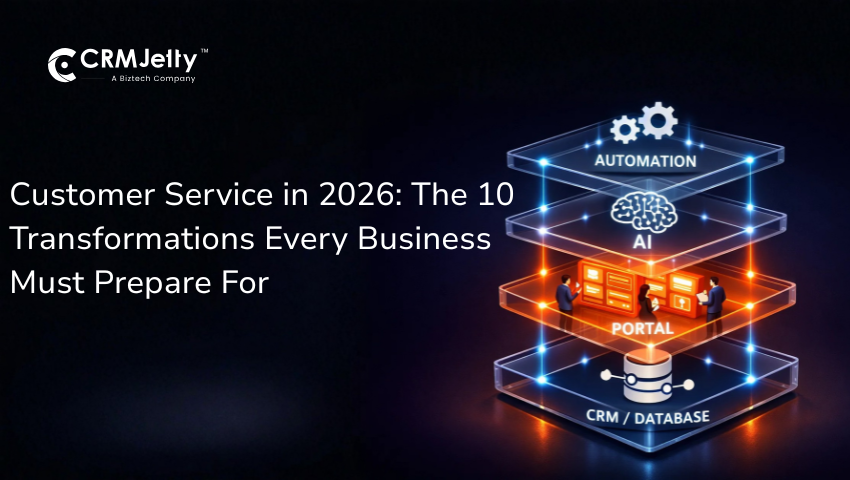
Transformation #10: CRM + Portals + AI = The New 2026 Customer Service Architecture
The 2026 customer service architecture requires four integrated layers working together. And they are:
CRM → System of Record Housing – Responsible for customer data, interaction history, and operational processes. The foundation everything builds on.
Portals → System of Experience – The customer-facing layer delivering self-service customer portals, personalized interfaces, unified access points. Where customers actually interact.
AI → System of Intelligence – Powering predictions, recommendations, automation triggers, and agent assistance. The smarts are making everything adaptive.
Automation → System of Efficiency – Handling workflows, escalations, notifications, and operational execution. The invisible machinery keeps things moving.
Miss any layer and the whole thing wobbles. CRM without portals locks data inside. Portals without AI feel static. AI without automation creates insights nobody acts on. Automation without CRM has nothing meaningful to automate.
The portal layer sits at the center of this architecture—connecting CRM foundations, AI capabilities, workflow automation, and user-facing experiences into journeys that actually feel coherent.
Action Plan for Businesses: Preparing for 2026
Knowing what’s coming means nothing without action. Here’s a practical sequence:
Step 1: Audit your current CX ecosystem. Honestly, identify specific gaps between what customers expect and what you actually deliver today.
Step 2: Enable genuine self-service. Deploy self-service customer portals capable of handling substantial interaction volume—not token portal pages with limited functionality.
Step 3: Integrate deeply with CRM. Whether Salesforce customer portal or Dynamics 365 customer portal implementations, surface connections matter. Shallow integration creates shallow results.
Step 4: Introduce automation systematically. Start with high-volume, predictable processes where rules-based automation delivers immediate ROI.
Step 5: Layer in AI-assisted support—knowledge access, intelligent case routing, agent assistance tools.
Step 6: Centralize data across channels and touchpoints. Kill the silos.
Step 7: Retrain agents on new workflows, emphasizing complex problem resolution over routine transaction processing.
The point isn’t replacing CRM investments you’ve already made, it’s modernizing how those investments actually reach customers.
Conclusion: The Portal-First Future Arrives
2026 will reward companies running a modern customer experience architecture. It penalizes those clinging to fragmented, reactive, channel-siloed approaches.
Customer service is going portal-first. The organizations that thrive operate unified portals integrated with CRM, enhanced by AI, and driven by automation. Not as a future ambition—as a current operational reality.
CRMJetty transforms your existing Salesforce or Dynamics 365 CRM into a complete customer experience engine. Customizable portal solutions featuring deep CRM integration, role-based security, automation-ready workflows, and deployment timelines measured in weeks rather than months.
CRMJetty accelerates modernization without requiring you to abandon technology investments you’ve already made. The 2026 customer expects more. They’re not wrong to. Modernize your support ecosystem with CRMJetty and get ahead of transformations already underway.
All product and company names are trademarks™, registered® or copyright© trademarks of their respective holders. Use of them does not imply any affiliation with or endorsement by them.