







Managing KYC document submission can feel overwhelming, and we completely understand why! FinTech companies handling customer onboarding are generally stuck working with outdated email chains, unsecured file-sharing systems, and manual verification processes.
Their teams rely on spreadsheets to track document expiry, scattered folders for storage, and constant follow-ups with customers who’ve submitted incomplete paperwork. Getting even a single customer fully verified means precious time wasted on back-and-forth emails.
And this is where the need for a better solution emerges. We know that FinTech firms worldwide aim to provide their customers with a secure KYC portal that enables them to submit documents seamlessly.
Additionally, they are always hunting for the best tools to provide instant visibility into verification progress while automating document routing and submission workflows.
The actual verification—OCR checks, biometric validation, and liveness detection—runs through third-party KYC APIs integrated via Salesforce workflows.
And this is where CRMJetty’s Salesforce Customer Portal can help businesses like you build a tailored, intelligent platform for secure KYC document submission.
Why Do FinTech Firms Want a Secure KYC Portal with Self-Service Capabilities?
Once firms realize that their scattered document collection methods create security vulnerabilities, the need for a smarter, unified solution becomes obvious. What they really want is a secure KYC portal that lets customers upload documents safely and helps compliance teams move from collection to verification without unnecessary manual intervention.
The first requirement that surfaces is to build a centralized document management hub for regulated financial services.
You may wonder, “Why use a portal specifically built for FinTech compliance workflows?”
Because CRMJetty provides the secure interface your customers use to submit KYC documents and track their verification status, while the actual identity checks (biometric validation, OCR scanning, liveness detection, etc.) are performed by third-party KYC APIs integrated through your CRM workflows.
With this setup, the portal ensures encrypted submission, audit-ready document storage, automated status updates, expiry tracking, and seamless document routing — while letting your preferred verification engine handle the compliance logic in the background.
This creates a faster, more transparent, and regulator-friendly onboarding experience without forcing your team to review every submission manually.
What Makes KYC Document Submission So Painful Right Now?
Data security risks sit at the top of every compliance officer’s worry list. When sensitive IDs and bank statements are sent as email attachments or shared via shared drives, you’re basically asking for trouble. One breach could trigger regulatory penalties that make your CFO lose sleep for months.

Manual processes create bottlenecks everywhere. Your team spends hours checking if documents are valid, tracking expiry dates in spreadsheets, and chasing customers for missing paperwork. Meanwhile, legitimate customers get frustrated waiting for approvals that should take minutes, not days.
Document expiry tracking becomes a full-time job nobody signed up for. Expired passports or outdated address proofs slip through the cracks, creating compliance gaps that auditors love to find during inspections.
Customer experience takes a hit when your submission process feels like asking your grandpa to text. Confusing upload instructions, unclear status updates, and zero visibility into verification progress push potential customers straight to competitors who’ve figured this out.
| Expert Tip:If you want to offer real-time document tracking features in your secure KYC portal, don’t forget about notification management. Check that your platform can intelligently filter alerts so customers don’t get overwhelmed with every status change. This single feature can save your support team from repetitive “where’s my verification” tickets and actually increase submission completion rates. In addition, it will improve trust in your onboarding process. |
Why a Secure KYC Portal Isn’t Optional for FinTech Compliance Anymore
Here’s what changes when you stop treating document security like an afterthought.
Your customer data gets protected through end-to-end encryption from the moment someone clicks “upload.” No more crossing your fingers and hoping email attachments don’t get intercepted. Access controls ensure only authorized team members can view sensitive information, which dramatically reduces your attack surface for FinTech compliance requirements.
Compliance becomes way less stressful when you’ve got audit trails automatically documenting every action. AML regulations, GDPR requirements, KYC standards – Your secure KYC portal captures and stores all documentation securely, while Salesforce workflows and integrated KYC APIs handle the verification logic. When regulators show up asking questions, you’ll have timestamped logs ready instead of scrambling through email archives at midnight.
Efficiency jumps immediately because automation handles the repetitive stuff. Document routing for KYC document submission happens based on rules you define once; Salesforce workflows trigger verification requests automatically by calling your connected third-party KYC verification APIs. Your team processes more applications with the same headcount, which means better unit economics for your FinTech operation.
Customer satisfaction improves when people can actually see what’s happening with their submission. Self-service customer portals enable them to upload documents on their schedule, track verification status in real-time, and proactively update expiring documents. Transparency builds trust faster than any marketing campaign ever could.
Key Features That Make CRMJetty’s Salesforce Customer Portal Actually Work
So what makes this different from yet another document upload tool?
Encrypted uploads happen automatically without customers needing to understand anything technical. They click, they upload, and security protocols handle the rest. Zero friction, maximum protection for KYC document submission.
Auto-expiry tracking monitors every document’s validity date and triggers notifications before things expire. Your customers get friendly reminders to renew their passports or update their address proof before FinTech compliance gaps appear. Your team gets dashboard visibility into upcoming expirations across your entire customer base.
Audit trails capture everything. Who uploaded what, when they uploaded it, who reviewed it, and what decision was made. Regulators love detailed documentation, and your self-service KYC portal creates it without anyone having to think about it.
User-friendly dashboards make self-service KYC actually work in practice. Customers see exactly which documents you need, what format works best, and where their submission stands in the verification queue. No PhD required to figure out the interface.
Automated Salesforce workflows route documents intelligently based on rules you configure and can trigger your connected KYC verification APIs wherever needed.. High-value customers might get priority review, certain document types might need specialist approval, and verification results sync automatically with your core systems.
Real Scenarios Where This Solves Actual Problems
Let’s look at how the solution solves some real use cases.
Getting KYC Document Submission Done Securely
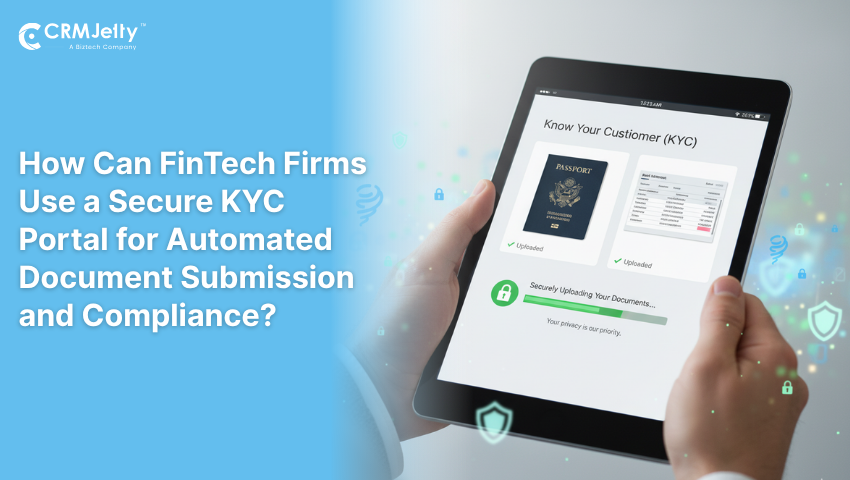
Picture this. Your customer needs to upload their passport and bank statement for account verification. In the old world, they’d attach files to an email and hit send, with zero idea whether that email’s encrypted or who might intercept it along the way.
With CRMJetty’s secure KYC portal, they log into a protected interface, drag and drop their documents, and encryption happens invisibly in the background. The difference? They feel confident their sensitive information stays private, and you avoid the nightmare scenario of a data breach traced back to unencrypted email attachments.
Staying Ahead of Document Expiration for FinTech Compliance
Here’s a scenario compliance teams know too well. A customer’s passport expires three months after they open their account. Nobody notices because tracking hundreds of expiry dates manually is basically impossible. Six months later, an auditor flags it during a review, and suddenly you’re explaining compliance gaps.
CRMJetty’s automated tracking watches every document’s expiration date and sends notifications at intervals you define—maybe 60 days out, 30 days out, and one week before expiry. Customers get proactive reminders through the self-service KYC interface, triggered by Salesforce workflows that actively monitor document expiry dates. Your compliance team gets a dashboard showing upcoming expirations across your customer base, turning reactive fire-fighting into proactive management.
| Expert Tip:When setting up expiry notifications in your secure KYC portal, don’t just fire off one reminder at the last minute and hope for the best. Configure a notification sequence that gives customers multiple chances to respond without feeling pressured. This approach significantly increases renewal rates and keeps your FinTech compliance metrics where they need to be. In addition, consider offering expedited re-verification for documents that have already expired to minimize gaps. |
Things That Can Change After You Implement the Secure KYC Portal
Once you roll out CRMJetty’s platform for self-service KYC, the difference becomes almost impossible to ignore. Trust us, you’ll wonder why you tolerated manual processes for this long.
Your compliance team will not have to chase customers through email threads, manually verify document formats, or update tracking spreadsheets just to know verification status. They can see everything in real time, automatically route documents based on preset rules, and stay aligned with FinTech compliance requirements through automated Salesforce workflows and integrated third-party verification APIs.
It is a no-brainer that when teams have visibility into the entire KYC document submission pipeline, compliance doesn’t drag out for weeks—it happens within days or even hours!
Security naturally goes up! When documents travel through encrypted channels in your secure KYC portal and access gets restricted to authorized personnel only, there is no room for the kind of data breaches that destroy reputations overnight. Additionally, this level of protection means fewer security incidents and fewer regulatory penalties. It also results in a much more trustworthy brand in your customers’ eyes.
Customer satisfaction improves because people can finally see where they stand. Self-service KYC portals show submission status, required documents, and verification progress without anyone having to call support. Transparency builds trust, and trust drives retention in ways that discount pricing never will.
Operational efficiency jumps dramatically when automation handles repetitive tasks for KYC document submission. Your team processes more applications with the same resources, onboarding timelines shrink from days to hours, and everyone focuses on higher-value work instead of administrative busywork that technology should handle.
Ready to Stop Treating KYC Document Submission Like a Manual Process?
Secure KYC document submission represents a make-or-break challenge for FinTech firms trying to scale. CRMJetty’s Salesforce Customer Portal addresses this by providing an automated, secure KYC portal that handles submission, verification, and FinTech compliance tracking without drowning your team in manual work.
The difference between struggling with scattered tools and operating a streamlined self-service KYC system comes down to implementing technology designed for regulatory compliance. When customers can submit documents securely, track status transparently, and receive proactive expiry notifications, everyone wins.
Your compliance team automatically receives audit-ready documentation. Your operations team gains efficiency, which directly translates into better unit economics. Your customers experience a FinTech company that treats their time and data security like it actually matters.
All product and company names are trademarks™, registered® or copyright© trademarks of their respective holders. Use of them does not imply any affiliation with or endorsement by them.