







Many insurance companies have started adopting a proper CRM system like Salesforce to streamline process management for their companies. Using a robust CRM like Salesforce means your data gets centralized, collaboration becomes easier, and you can achieve optimal operational efficiency.
Although Salesforce is a phenomenal CRM system, when it is tethered to legacy systems, it cannot be used to its full potential. So, instead of top-notch operational efficiency, you get a broken network, an amazing (but unused) CRM, and a lot of confusion as to where things are going wrong?
If you are also observing your team juggle between Salesforce and multiple legacy screens, waiting for the critical data to sync, then dear reader, you are experiencing a legacy system trap. Your Salesforce investment isn’t delivering its full potential because it’s chained to systems that were never designed for today’s real-time, customer-centric world.
So what’s the solution? Well, how about adding an integration that supports your Salesforce ecosystem and replaces your legacy system?
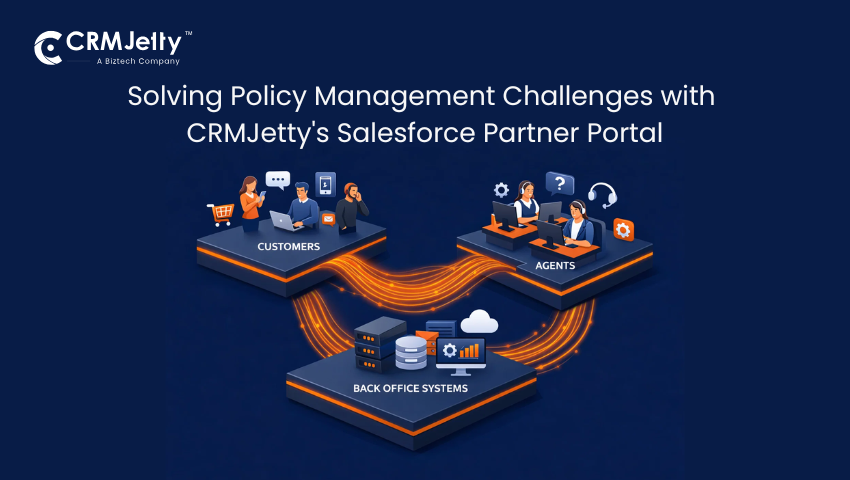
We are talking about a solution that helps you streamline communication and coordination among your users, agents, and back-office systems. You get to leverage an end-to-end platform that helps you reimagine how insurance portal solutions should work. At the same time, your customers get to experience best-of-a-kind services.
And one of the leading solutions in this category is CRMJetty’s Salesforce partner portal. It is a versatile solution that will streamline your current processes while ensuring your market stronghold in the future. But, first,
What are the Challenges that Insurance Companies Face?
The broken system leads to inaccuracies and delays and may also compromise regulatory compliance. Here are some of the prominent drawbacks that you must have been facing or will face in the near future:
Insurance companies rely heavily on manual data entry for policy updates and renewals. This increases the risk of human error, such as incorrect customer information, premiums, or policy coverage.
-
Inaccuracies in Data Entry
Many good insurance companies still use a traditional data entry system to manage policy updates and renewals, even though they have a CRM that can automate it. This increases the risk of human error and causes delays.
This is especially challenging because for the insurance company, data accuracy is non-negotiable. They need accurate customer information, premium details, and policy documents to process the claim.
-
Delay in Claim Processing
Handling multiple claims becomes a challenge due to disconnected systems, which leads to delays in claim processing. These delays also reflect in your customer service, in the form of forgotten reminder emails and tiring query resolution.
Lack of clarity hinders operational efficiency; a simple query about the claim process timeline requires hours as documents and information are scattered across multiple systems. A simple query, “How long will it take to process my claim?” takes hours to resolve.
-
Poor Communication
Fragmented channels leave little to no room for proper communication between agents, customers, and back offices. A lot of back-and-forth over the same issue keeps your agent busy and your customers disappointed, while the back office is out of the picture.
Things take time to resolve because of a lack of proper communication channels; documents are shared and stored in soft copies, while the claim is filed by submitting a form. Since there is no portal to connect the agent with the customer, their conversation occurs over the phone.
-
Regulatory Compliance
Without any proper system in place, ensuring adherence to constantly evolving compliance requirements also becomes a time-consuming, resource-intensive task. As processes become more sophisticated, managing regulatory compliance manually is increasingly complex.
Implementing a robust CRM is the right step, but if it isn’t connected to a solid infrastructure, processes will remain chaotic. Scattered data, limited visibility, and inadequate management systems raise serious compliance concerns that should be addressed.
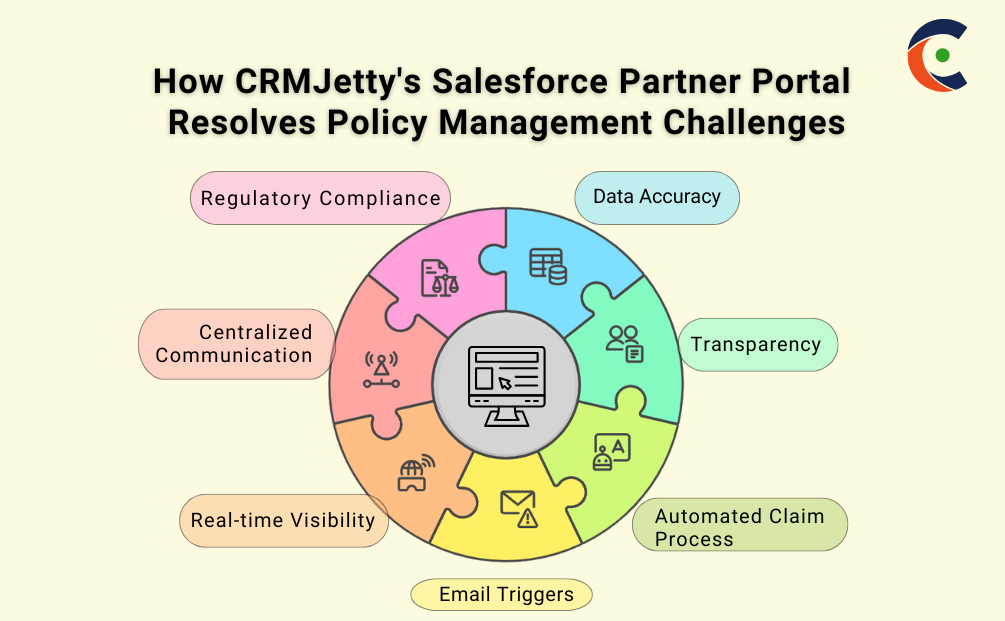
Use Case 1: Inaccurate Policy Data & Errors in Renewals
The Problem Nobody Talks About
Almost every insurance company’s back office looks similar, same old systems with employees hunched over keyboards manually working on customer information, policy details, and renewal dates. This is the kind of situation where one small mistake can snowball into a whole round of errors that cannot even be traced back to its origin.
And other than errors, the whole process itself gets very slow. Due to manual updates, policy renewals are often delayed or processed wrong. The thing is, there is already a delay, and on top of that, these errors further extend the process.
How CRMJetty Salesforce Partner Portal Corrects These Errors
CRMJetty’s insurance policy management solution tackles this with User Activity Management that records everything on your Salesforce dashboard. Every single action, whether it is someone logging in at 3 PM, viewing Mrs. Johnson’s policy documents, or updating coverage amounts, gets recorded automatically. Thus eliminating the need for backtracking the steps.
Another smart feature that CRMJetty’s Salesforce partner portal offers is role-based redirection, i.e., directing users to their relevant dashboards. For instance, if a customer logs in to their account, they will see their own information relevant to the claim and track the progress if applied for one.
Similarly, in the case of your internal teams, the agents will get access to their leads, progress, and closures. While, the renewal specialists, or claim processors, will be redirected to their respective dashboards.
Do you see how easy and time-efficient everything will get? You will be able to automate renewal notifications, implement real-time policy updates, and ensure transparency with a digital trail. You won’t just improve but also secure the process for your team.
The Real Impact:
- Improved Data Accuracy: Through process automation and accountability.
- Faster Renewals: With easy role-specific data access.
- Enhanced Customer Services: Faster, on-time renewals improve customer experience.
Use Case 2: Manual Claims Processing & Slow Response Times
Why Claims Still Move at Snail’s Pace
The biggest drawback of manual data management is, files get lost very easily. Why? Because there is no accurate digital trace. Your customer sends you the claim document, and you record it in the system manually (which would likely have at least a few errors, if not many). Not to mention, this makes information retrieval a challenge too.
The thing is, apart from the paperwork, there is also a lack of transparency in the process. There is no real-time tracking system, so customers have to call you again and again which adds to the delay and frustration.
CRMJetty’s Approach to Claims Automation
This is where you will see how efficient CRMJetty’s claims processing automation is. Its filter functionality on dashboards lets your agents and customers filter claims data across all components. Lists, charts, KPIs, everything updates in real-time to show precisely what’s happening with each claim.
Customers can upload attachments directly through the portal. No more “please mail us three copies of your invoice.” They leverage the ease of uploading their documents and photos through a portal, while your team gets an organized documentation with every detail they seek in one place.
Another benefit that CRMJetty’s Salesforce partner portal offers is automatic email triggers. Every update triggers an email notification to all the stakeholders. So if the claim has moved from “in review” to “approved,” the customer will get notified.
All of these features accelerate claim processing and reduce workload on your agent. It also gives your customers clarity regarding what is happening behind the scenes and where their claim management journey is headed. It improves transparency while allowing your agents to focus on more meaningful work instead of answering customer questions.
Real World Results
- Faster Claims Resolution: With the help of filter functionality
- Improved Customer Transparency: Real-time updates help bring clarity for everyone involved
- Operational Efficiency: Automation and immediate updates help improve processes
Some business owners remain uncertain and ask us, “How can CRMJetty’s claims automation improve overall claims processing efficiency and reduce customer inquiries?”
The automation essentially creates a self-updating system where every action triggers appropriate notifications and updates. Your team can implement filters that automatically prioritize high-value or time-sensitive claims, while customers get real-time visibility that eliminates most follow-up calls. It’s not just about speed, it’s about creating transparency throughout the ecosystem that builds trust.
Use Case 3: Fragmented Communication Between Agents & Customers
The Communication Maze
Another very common yet often overlooked issue is fragmented communication channels. Your agents and customers connect by phone, share documents via email, and fill in additional details with post-its.
This makes even basic information, like their deductibles or policy renewal dates, inaccessible. It keeps your agents busy with redundant questions while the customer feels they are out of the loop every time.
Simplifying Communication with CRMJetty
CRMJetty’s Case Management system revolutionizes this chaos by creating a single source of accurate information. Every interaction, whether it’s a phone call about coverage, an email about a claim, or a portal message about billing, gets logged in one centralized system.
Dashboard Management takes this further by giving agents real-time visibility into everything happening with their customers. Active cases show up in one column, pending inquiries in another, and upcoming renewals trigger alerts when they’re due.
Lastly, the support Module empowers customers through self-service. They can implement their own inquiries through the insurance customer portal, check claim statuses without calling, and get answers to common questions instantly.
CRMJetty’s Salesforce partner portal provides a comprehensive overview of customer history, including previous interactions, to support future communications. This also helps with case transfers if the current agent is unavailable for an extended period.
Positive Impact:
- Faster Response Time: By automating routine inquiries and task prioritization
- Improved Communication: With the help of a unified platform and easy data accessibility
- Increased Efficiency: By implementing multi-site support and role-based access
If the roadblocks mentioned above are your reality, it is time to upgrade your infrastructure to meet current-day requirements. See how CRMJetty’s Salesforce partner portal can help you achieve that.
Use Case 4: Compliance and Regulatory Issues
The Compliance Nightmare
Regulatory compliance in insurance isn’t just about following rules, but it’s about proving you followed them. Manual compliance checks mean your staff are literally going through stacks of documents, hoping they haven’t missed anything. One overlooked requirement, one missed signature, can lead to regulatory complications and a series of fines.
But here’s the thing, most compliance violations aren’t intentional. It happens due to inconsistencies in the process and documentation. In some cases, the team doesn’t know about new requirements because there’s no system to manage alerts.
CRMJetty’s Compliance Framework
CRMJetty’s insurance administration software approaches compliance differently. Instead of adding more checklists, it builds compliance into every action. Automated Activity & Audit Tracking tracks every policy update, every payment and billing processed, and every claim adjusted, leaving a permanent digital footprint.
Role-based Access Controls ensure only authorized users can modify sensitive data. Your junior agents can view policies but can’t modify premium calculations. Claims processors can update claim status but can’t alter coverage terms.
Dashboard Management gives compliance officers a bird’s-eye view of potential issues before they become problems. Policies approaching renewal without proper documentation and claims with missing forms are automatically flagged. You can implement preventive compliance instead of reactive scrambling.
The Document Management system keeps everything in one searchable, secure location. This will be a great asset during audits and for transaction verification. Why? Because it will pull all required data into a single, secure space.
The Real Impact:
- Reduced Risk of Non-Compliance: With the help of tracking automation
- Simplified Audits: Through a well-organized system
- Operational Efficiency: Less manual work, more focus
- Enhanced Trust: With proper management systems in place
Final Thoughts
The insurance industry has been slow to embrace digital transformation. But companies that continue relying on manual processes and disconnected systems aren’t just falling behind; they’re actively frustrating customers and burning through resources unnecessarily.
CRMJetty’s Salesforce partner portal offers something different. Through User Activity Management, Multi-Site Support, Role-based Redirection, and the Custom Widget Builder, it addresses the real challenges insurance companies face. You can improve data accuracy to reduce costly errors, streamline claims processing to move at modern speeds, and deliver transparent, responsive service that keeps customers loyal.
The question isn’t whether you need to modernize your insurance operations—it’s whether you’ll do it before your competitors do.
If you’re ready to see how CRMJetty’s portal can transform your insurance operations and finally deliver that seamless user experience everyone’s talking about, request a demo today. See for yourself how the right insurance portal solutions can turn operational headaches into competitive advantages.
All product and company names are trademarks™, registered® or copyright© trademarks of their respective holders. Use of them does not imply any affiliation with or endorsement by them.