








Partner-led sales are not slowing down. If anything, indirect revenue now drives a serious chunk of bookings for Salesforce-powered businesses. But managing that ecosystem with spreadsheets and scattered email threads? That breaks down fast.
A lot of businesses trust Salesforce to handle their data and processes, in fact, the Salesforce consulting service market size is valued to reach USD 57.00 billion by 2032 (Source). For them, a Salesforce partner portal changes this equation.
Think of it as a controlled bridge with your CRM data on one side, your partner network on the other. Partners get what they need to collaborate on deals and stay looped in, while your internal team controls what’s exposed.
Most teams start by looking at Salesforce Experience Cloud. Native platform, enterprise security, big ecosystem backing it. Logical starting point. But here’s what catches people off guard. Experience Cloud isn’t exactly simple.
Salesforce Experience Cloud is not that easy to handle. The implementation timeline stretches, the cost climbs faster, and if you don’t have a Salesforce developer ready for work at all times, your business will probably go through a series of roadblocks. In contrast, the goal is to achieve something opposite – a streamlined, well-connected operational system.
And none of these means that Experience Cloud is wrong. It just means it’s not automatically right for everyone. So what’s the solution? That’s what you need to decide based on your unique requirements and how you want to operate your business.
What Is a Salesforce Partner Portal?
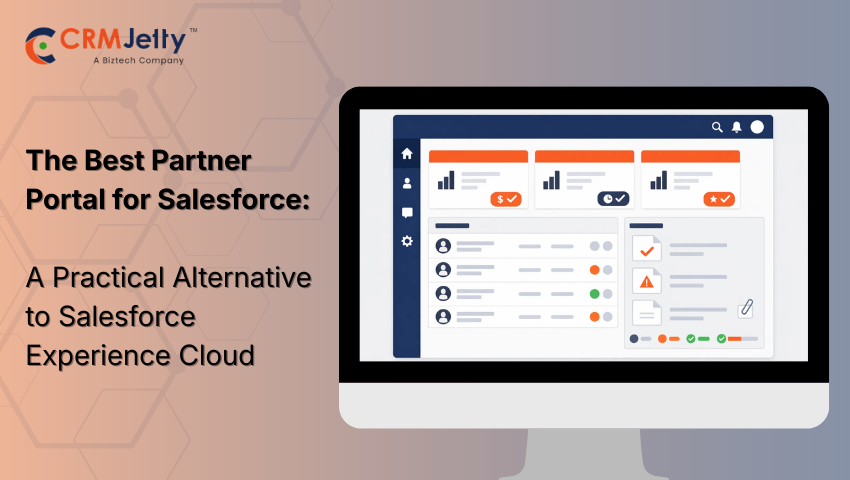
To put it simply, the Salesforce partner portal is a window into your CRM. A controlled one. Built for people outside your company, i.e., partners who need access to specific data without wandering through your entire Salesforce ecosystem.
What do partners do with this portal?
- Access leads and opportunities: They can view deals, update statuses, and track progress without ever logging into Salesforce directly.
- Collaborate on deals: Real-time visibility of stages, approvals, and pending actions keeps everyone on the same page without the back-and-forth.
- Grab documents: Pricing sheets, contracts, sales collateral, all the documents can be found in one spot instead of being buried in inboxes.
- Get updates: No more “just checking in” emails. Information flows through the portal.
A partner portal isn’t a full-blown PRM platform. PRM systems go wider—incentive tracking, learning management, analytics dashboards. Portals focus tighter on CRM data access and deal collaboration.
And portal doesn’t mean everyone gets access to CRM data because it isn’t needed either. Partners don’t want to navigate Salesforce’s complex interface. They just want to see the stuff that matters to them, presented in a simple, easy-to-understand format.
This is why the portal is a better choice than licensing every partner user, which can get very expensive and unnecessary for partners who don’t even need all that in the first place.
Now you might wonder, “If partners access Salesforce data through a portal, how can one make sure they only see what’s relevant to them?”
And the solution to that is role-based access. You set visibility rules by partner type, region, tier—whatever makes sense for your setup. So your partners will see exactly the records they’re supposed to see. Nothing extra. Granular permission structures can be configured to align with your existing Salesforce security architecture from the start.
Salesforce Experience Cloud as a Partner Portal
Experience Cloud is a solid option for building partner portals. For certain organizations, it’s genuinely the right call.
What’s on offer:
Experience Cloud gives you a native Salesforce environment for external-facing portals. It sits on top of your org, so data moves without the need for integration gymnastics. Enterprise-grade security comes standard. And if you want deep customization, Lightning components and Salesforce’s dev framework give you room to build.
Where it really works:
Large enterprises with layered, complex Salesforce environments get the most out of Experience Cloud. This is because Experience Cloud can handle everything, heavy investment in custom objects, automation and advanced workflows.
Teams with in-house Salesforce developers benefit too. When you’ve got certified folks who know the platform inside out, building and maintaining an Experience Cloud portal becomes manageable.
And for partner ecosystems that need tight integration with Marketing Cloud, Service Cloud, or other Salesforce products—Experience Cloud’s native connectivity has clear advantages.
Where Salesforce Experience Cloud Becomes Challenging
That said, Experience Cloud has some practical limitations as well. Initially, these limitations look so minute that teams tend to underestimate them until they’re already deep into implementation.
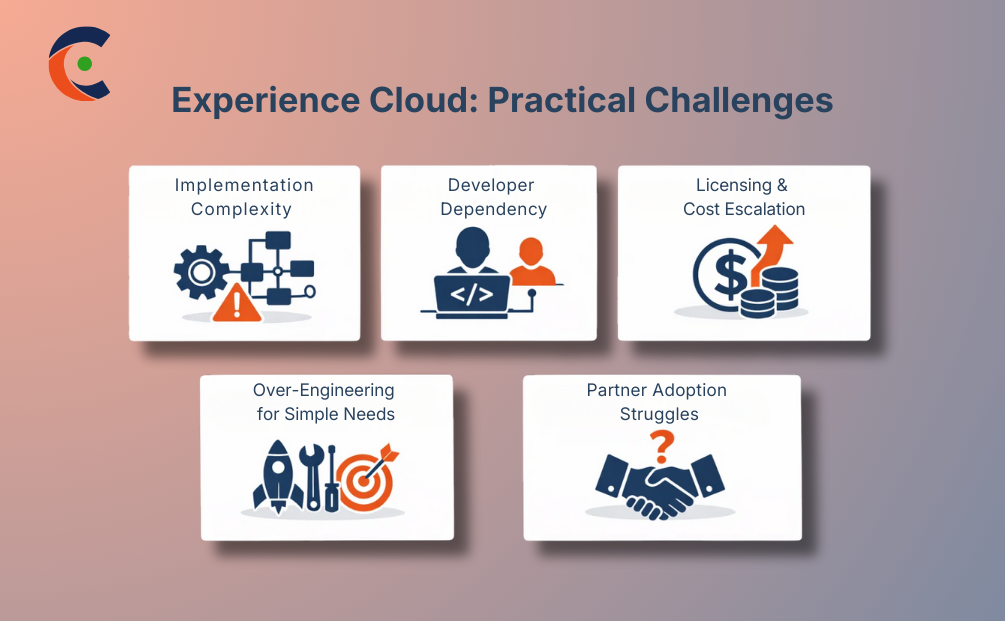
- Setup isn’t quick: Experience Cloud requires real configuration work, custom development, and testing cycles. Timelines often run longer than initial estimates suggested.
- Need for Salesforce developers: Without skilled developers, minor technical issues become significant roadblocks, and the platform’s flexibility becomes a source of complexity. Matching it to your partner workflows takes technical know-how.
- Licensing adds up: Experience Cloud costs can rise as partner programs grow. Per-user pricing catches some organizations off guard when they tally up the full investment.
- Overkill for simpler needs: Here’s a pattern that surfaces regularly. A company wants straightforward partner access, i.e., deal registration, document sharing, and pipeline visibility. Experience Cloud handles this, but it’s engineered for much more. You end up managing capabilities that sit unused.
- Partners aren’t power users: If your portal feels like navigating a full CRM, adoption drops. Some Experience Cloud setups struggle here because the interface, while capable, wasn’t designed with external users as the primary audience.
These are practical considerations, not criticisms. Understanding them sharpens the decision about what’s genuinely the best Salesforce partner portal for your particular situation.
What Businesses Actually Need from a Salesforce Partner Portal?
Not the feature checklist, but here’s what businesses actually expect when they invest in Salesforce Experience Cloud:
- Controlled access to Salesforce data: Partners need leads, opportunities, and documents. Not the internal dashboards or unrelated records. And that’s what businesses want the partner portal to do, give controlled access to the data.
- Role-based visibility: Distributors and referral partners have different needs. Regional agents need different views than global resellers. Your portal should handle these variations without requiring workarounds.
- A clean, branded experience: Partners work with multiple vendors. A professional portal that reflects your brand, rather than generic Salesforce styling, affects how seriously they take the relationship. So your partner-facing portal becomes your brand image.
- Faster time to launch: Six months of development before go-live? That’s momentum lost. Speed matters. So a portal that delivers quality at speed is what businesses seek. Something that can be integrated quickly, is easy to understand, and user-friendly.
- Costs that stay predictable: As partner counts grow, pricing shouldn’t spiral out of control. Scalable models protect budgets. This gives businesses ample space to grow and scale their operations without worrying about rising investment costs.
- Actual adoption: The most sophisticated portal means nothing if partners don’t use it. Usability drives everything. So, businesses seek an easy-to-use portal from their Salesforce partner portal when they invest in one.
A More Flexible Alternative to Experience Cloud
Given what’s outlined above, it makes sense that organizations look beyond native Salesforce options when hunting for the best partner portal for Salesforce.
The core question: does everything need to live inside Salesforce, or can you extend Salesforce with a dedicated portal layer?
Building entirely within Salesforce (Experience Cloud route) fits when requirements tie deeply to complex Salesforce customizations. But plenty of partner programs don’t need that depth.
Extending Salesforce through a purpose-built portal takes a different path. Salesforce stays your source of facts. Partners get streamlined, secure access through an interface that’s typically faster to deploy and simpler to maintain.
When does an alternative tend to make sense?
SMBs and mid-market companies often lack internal Salesforce expertise for Experience Cloud. Growing partner programs need velocity, and months-long portal launches mean missed windows. So for teams focused on usability over feature density, adoption drives ROI matters more than technical sophistication does.
CRMJetty Salesforce Partner Portal: A Practical Alternative
CRMJetty’s Salesforce Partner Portal works as an additional layer sitting on top of Salesforce. It can extend your data to partners without the overhead that typically comes with Experience Cloud.
How it works:
The portal will connect to Salesforce and surface data in accordance with your existing sharing rules and security model. All business logic will still stay in Salesforce—the portal won’t duplicate or override it. Partners will interact through a streamlined interface built for external users, not a watered-down version of the full CRM.
Capabilities that can typically be implemented:
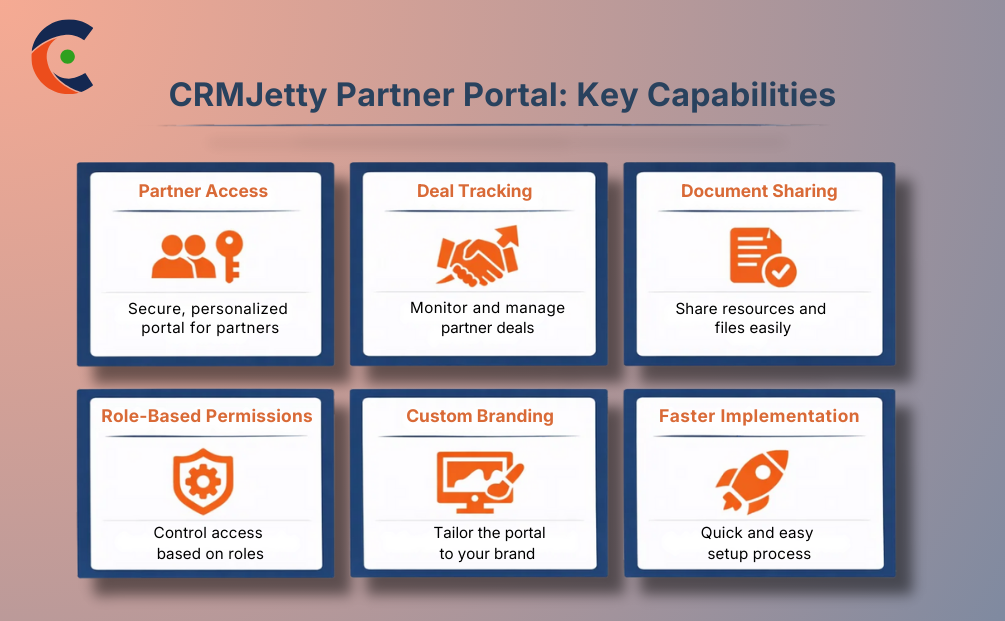
- Information access to partners: Partners will be able to view relevant Salesforce data in real time, and updates will sync back automatically.
- Deal tracking and collaboration: Deal registration, approval workflows, and pipeline visibility will become accessible through the portal, with status updates that partners can check themselves.
- Document sharing: The portal will create a centralized repository for all partners to access required documents, contracts, resources, and other collateral in a designated space.
- Role-based permissions: Different partner types will get tailored views and access levels based on how you configure visibility.
- Custom branding and white-labeling: Your portal will carry your brand. So what partners will see is a professional interface that looks like it’s part of your organization, not a generic tool.
- Faster implementation: Because the portal targets partner use cases specifically, deployment timelines tend to compress significantly, though complexity still affects duration.
Where CRMJetty typically fits well:
SMBs and mid-market teams looking for the best Salesforce partner portal without enterprise-level overhead. Organizations that are prioritizing flexibility and speed over extensive customization. Teams where partner usability and adoption matter more than deep feature sets.
Experience Cloud vs CRMJetty: What’s the Difference?
Which option fits depends on context. Here’s how they generally compare:
|
Criteria |
Salesforce Experience Cloud |
CRMJetty Salesforce Partner Portal |
| Implementation Time | Often longer (months, varies with complexity) | Typically faster for standard use cases |
| Salesforce Dependency | Generally requires Salesforce developers | Lower technical dependency in most scenarios |
| Customization Effort | High effort, high flexibility | Moderate effort, purpose-built for partner workflows |
| Cost Scalability | Per-user licensing can increase costs at scale | Pricing is typically more predictable as partners grow |
| Partner Usability | Varies based on implementation approach | Designed with external user adoption in mind |
| Ideal Business Size | Often better suited for larger enterprises | Often better suited for SMBs and mid-market |
Neither option wins universally. The right pick depends on technical resources, timeline pressure, and the complexity of your partner program.
Evaluating your options? A brief assessment can help determine whether your partner program needs enterprise-grade complexity—or a more agile approach.
When Experience Cloud Is the Right Choice
Experience Cloud makes strong sense in certain situations, such as:
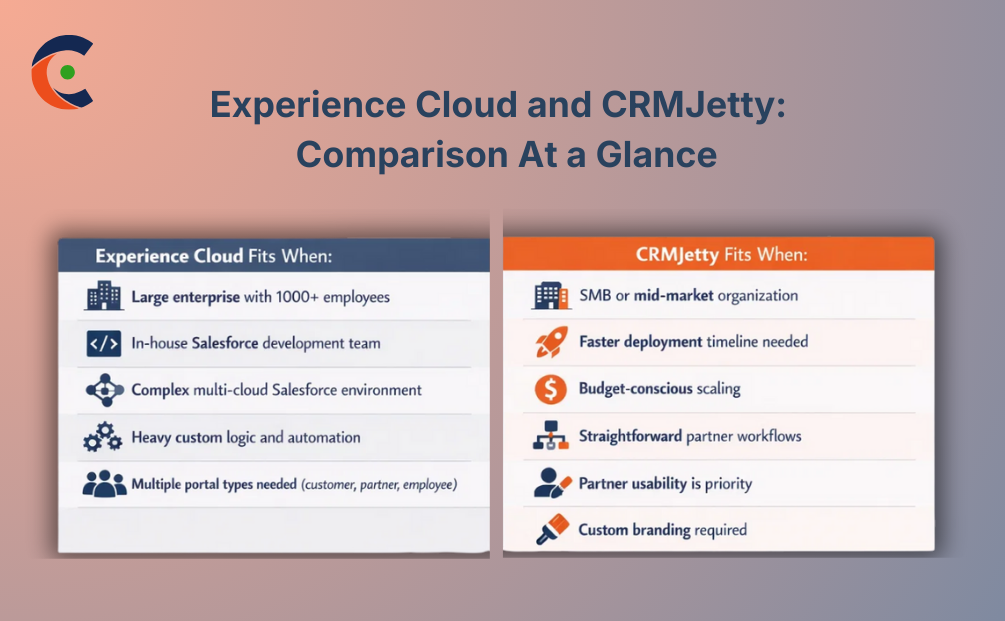
- Enterprises with dedicated Salesforce ecosystem: Companies with complex Salesforce environments containing extensive custom objects, intricate automation, and integrations with other Salesforce clouds. Experience Cloud’s native connectivity handles this well.
- Heavy custom logic already living in Salesforce: When business processes depend on complex workflows, validation rules, and approval processes, a native portal keeps that logic consistent. So, Experience Cloud can be a better option.
- Dedicated Salesforce development teams available: Organizations with certified developers on staff can manage Experience Cloud’s complexity and customize to precise specs. For them, Experience Cloud naturally becomes the practical option.
- Multi-community requirements: If you need partner portals, customer portals, and employee portals all integrated within Salesforce, Experience Cloud’s architecture supports that consolidation. It keeps the whole process in the native ecosystem.
When CRMJetty Is the Better Fit
CRMJetty’s Salesforce Partner Portal tends to work better when:
- Faster deployment matters: CRMJetty is added to the existing ecosystem as an additional operational layer, which allows you to go live sooner. For businesses like SMBs seeking faster deployments, CRMJetty can be a better option.
- Budget sensitivity is real: Predictable pricing without per-user escalation helps protect budgets as partner ecosystems expand. Businesses can budget their investments accordingly because pricing remains relatively consistent.
- Partner workflows stay relatively straightforward: Deal registration, pipeline visibility, document sharing, everything happens without layers of complex automation. All the functionalities fit well into a purpose-built portal.
- Easy adoption and third-party tool integration: Portals designed for external users from the ground up tend to see stronger adoption than interfaces adapted from enterprise CRM systems. They can easily connect with their resources via APIs.
- You need role-based Salesforce access: Partners come in with different prerequisites and thereby require different access levels, which can be achieved with CRMJetty. The solution offers ample flexibility to customize it to your workflow.
FAQs About Salesforce Partner Portals
A lot of businesses often have the following queries when it comes to choosing the best Salesforce partner portal, so to answer some of them in context with CRMJetty,
Do partners need Salesforce licenses to access a partner portal?
No. Partner portals are designed to provide Salesforce data access without requiring every partner user to have a full license. Both Experience Cloud (with appropriate license types) and solutions like CRMJetty enable external access without standard Salesforce licenses.
Is Experience Cloud required for building a Salesforce partner portal?
Not necessarily, Experience Cloud is one option, while a dedicated portal is another. The portal allows partners to access the data without having to enter the whole CRM ecosystem. As for which option is better? It depends on the requirement complexity, budget, and the preferred launch timeline.
How secure is external partner access to Salesforce data?
Properly configured portals implement role-based access control that respects Salesforce’s sharing model. Partners see only authorized records. Security features like SSO, multi-factor authentication, and encryption protect data during access and transmission.
How long does implementation typically take?
It varies. Experience Cloud implementations often take several months, depending on complexity. Purpose-built solutions like CRMJetty typically deploy faster for standard partner use cases, though timelines still depend on specific requirements.
Can portal access be customized for different partner types?
Yes. Role-based permissions let you define different access levels, visible fields, and available actions for various partner types—distributors, resellers, referral partners, regional agents, and others.
So, Which Option is the Best Partner Portal for Salesforce?
Picking the best partner portal for Salesforce isn’t about choosing one solution as universally superior. It’s about matching capabilities to your organization’s scale, complexity, technical bench, and timeline.
Experience Cloud brings deep native integration and serious flexibility—with corresponding complexity and cost. CRMJetty offers a more streamlined alternative that typically gets partner programs up and running faster, with more predictable pricing.
The question worth asking: which platform fits where your organization’s workflow sits today—and where it needs to go?
Complexity isn’t a requirement. Speed and usability might be. See what a purpose-built partner portal looks like for your Salesforce ecosystem.
All product and company names are trademarks™, registered® or copyright© trademarks of their respective holders. Use of them does not imply any affiliation with or endorsement by them.