








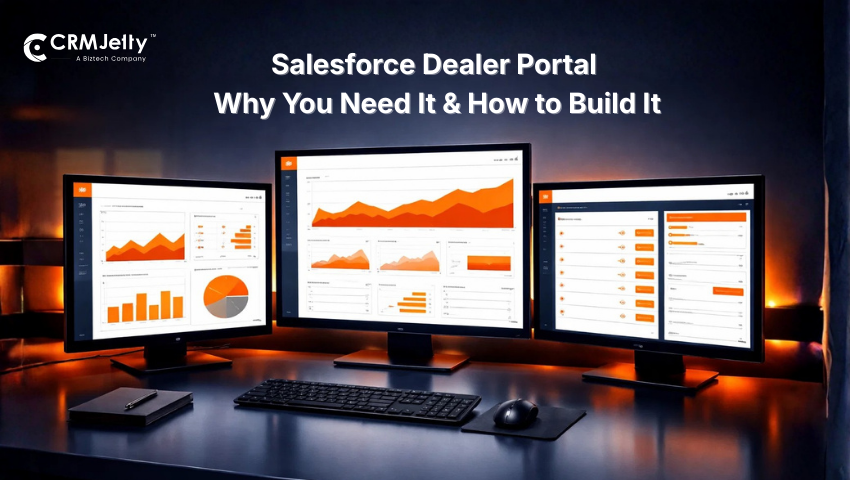
Dealer and distributor ecosystems are the backbone of many B2B growth strategies. Whether you operate in manufacturing, automotive, or wholesale distribution, your dealers represent your brand in the market.
But here’s the problem: most organizations still manage dealer communication through email, spreadsheets, shared drives, and manual reporting that is poorly maintained. This patchwork approach kills momentum and keeps everyone guessing.
A Salesforce dealer portal can fix this. A solution that sits on top of your existing CRM and creates a proper collaboration space for external partners. Many organizations build these dealer ecosystems using partner portal frameworks designed specifically for Salesforce so dealer management can grow without the operational headaches that typically accompany it.
What Is a Salesforce Dealer Portal?
For many B2B businesses, a major share of revenue comes from partners, and about 67% of business owners expect partner revenue to grow. But without a proper system in place, this growth can easily turn into a challenge.
This is where the Salesforce dealer portal becomes the ideal solution. It provides dealers and distributors with a secure, web-based view of relevant CRM data without granting them direct Salesforce login credentials. It’s essentially an external collaboration layer.
The dealer is configured as an external user in Salesforce, enabling your team to implement partner-style access. What this does is it allows them ample access to see their orders, cases, documents, etc., without them actually entering the internal CRM ecosystem.
Salesforce dealer portal extends Salesforce data outward through role-based permissions, dashboards, and automated workflows. Dealers get secure, real-time access to business information. Your internal teams keep full control over who sees what, who can do what, and how data gets shared. Collaboration and compliance, working together.
Why Businesses Need a Salesforce Dealer Portal
Dealer networks don’t stay small. And as they grow, so does the operational mess. Managing distributors through manual processes hits a wall faster than most companies expect.
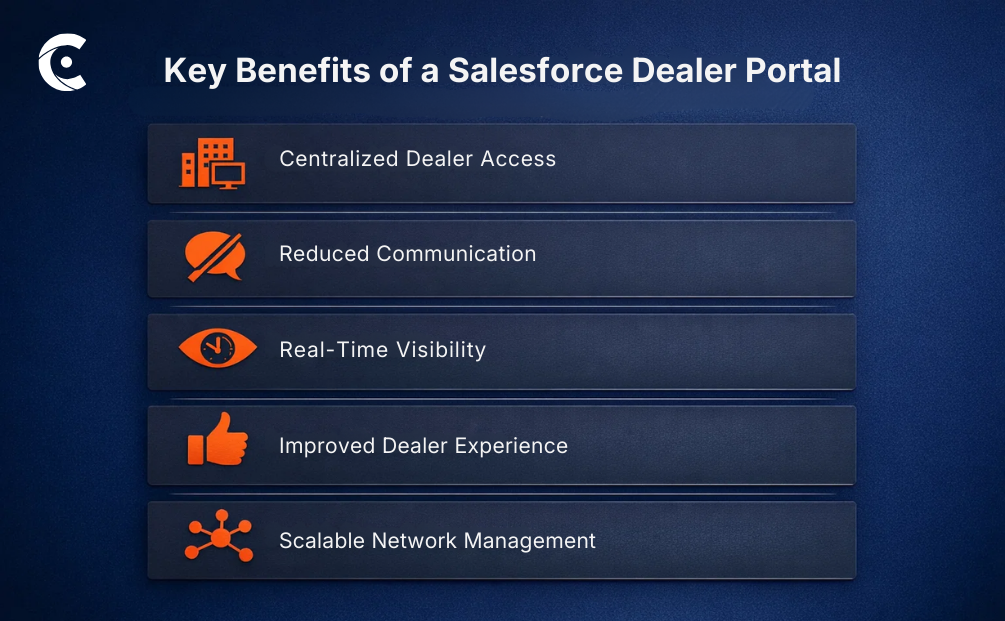
A Salesforce dealer portal tackles several pain points head-on.
- Centralized Dealer Access: No more hunting through email chains. Dealers log into one platform for orders, support cases, product updates, and documentation.
- Reduced Manual Communication: Your sales and operations teams will no longer have to deal with the same questions over and over again. Dealers get a dedicated portal to answer all the questions.
- Real-Time Visibility: Dealers can pull all the data, like order status, service requests, account updates, etc., directly from CRM data instead of waiting for someone to compile a report.
- Improved Dealer Experience: Partners who can actually see what’s happening tend to trust you more. Collaboration gets easier when information flows freely.
- Scalable Network Management: Add new regions. Add new product lines. The portal structure scales without requiring you to hire additional coordinators.
Bottom line is that a Salesforce dealer portal isn’t just a tech upgrade. It’s a strategic move toward channel growth, operational sanity, and partners who actually want to work with you.
Key Features of a Salesforce Dealer Portal
The best dealer portal implementations balance three things: usability, visibility, and control.
- Secure Login & Role-Based Access: Dealers authenticate through the portal. Permissions lock down data so each partner sees only their own information.
- Order & Case Visibility: Dealers track order fulfillment, submit service requests, and monitor case progress without pinging your internal teams every few hours.
- Document Access & Uploads: Price lists, product manuals, contracts, and compliance paperwork, everything can be condensed in one place. Dealers upload their documents there, too.
- Self-Service Knowledge Base: Easily accessible training materials, FAQs, and troubleshooting guides help dealers resolve their own issues when possible.
- Dealer-Specific Dashboards: Every dealer gets a dedicated dashboard that shows their key performance metrics, including revenue contribution, pipeline status, and more.
These features shift dealer relationships from reactive email chains to proactive collaboration. CRM data powers everything, but dealers interact through an interface built for them.
How a Salesforce Dealer Portal Works
The technical side follows a pretty straightforward framework.
First, dealers get set up as portal users in Salesforce. Roles, profiles, and sharing rules control exactly what data they can access. The portal runs securely on Salesforce Experience Cloud and can be customized with your branding.
Since the portal integrates with Salesforce, all the data stays synchronized. Case updates, order changes, document uploads—all of it reflects in real time on both sides.
Common Dealer Portal Use Cases
Salesforce dealer portal is useful whenever there are indirect sales models, for instance:
- Manufacturing Dealer Networks will use the portal to check inventory levels, pricing structures, and order pipelines.
- Automotive Distributors will be able to handle vehicle allocation, service cases, and warranty claims via the portal dedicated to their operations.
- Equipment & Machinery Dealers will be able to track spare parts availability along with the service schedules and technical documentation.
- B2B Wholesale Partners can collaborate and coordinate to fulfill bulk orders and fulfillment logistics.
Shifting to a new technology is difficult, so there are surely some doubts regarding data handling and integrity. One of the commonly asked questions from a lot of decision makers’ end is, “How do we make sure dealers only see their own customers and orders?”
The answer is that role hierarchies and sharing rules handle this. Data visibility gets restricted to each dealer’s specific accounts and transactions. They collaborate with you—not with each other’s confidential information.
Best Practices for a Successful Dealer Portal
Technology alone doesn’t make a Salesforce dealer portal a successful integration; it should always be paired with best practices that make adoption successful, strategic, and well-planned. Some of those practices include:
- Role-Based Access Design: To map out visibility structures before you launch anything.
- Clear Navigation & Usability: So dealers could find what they need in two or three clicks, not ten.
- Dealer Onboarding & Training: So you don’t have to just hand over login credentials because structured onboarding gets dealers productive faster.
- Regular Permission Audits: Networks evolve. Access reviews keep security tight as partners come and go.
- Analytics & Adoption Tracking: Monitor metrics, usage patterns, engagement rates, and feature adoption, they tell you what’s working and what needs attention.
Organizations that treat dealer portals as long-term collaboration platforms and not just one-time IT projects consistently see better ROI and stronger partner engagement.
Challenges in Dealer Portal Implementation & How to Overcome Them
Like every technology, Salesforce dealer portal implementation also has its own set of friction points. But with the right tools and techniques, it can be streamlined easily.
- Security Concerns: Opening CRM data to external users raises security concerns, but controlled authentication and strict role-based access control keep exposure manageable.
- Data Visibility Conflicts: Sloppy sharing rules create problems where dealers either have access to more information than needed or too little, so get the configuration right upfront to avoid this issue.
- User Adoption Barriers: Dealers often resist unfamiliar systems, especially when they lack training, so ensure everyone is well-informed and trained throughout the transformation.
- Customization Complexity: Every dealer network has its own unique operational structure that demands tailored workflows, so make sure that the dealer portal offers ample flexibility to accommodate that.
A partner portal that doesn’t demand any specialized implementation accelerators resolves these challenges. So you get to access the flexibility without changing your CRM logic or sacrificing the governance.
How CRMJetty’s Salesforce Partner Portal Supports Dealer Networks
Scaling a dealer ecosystem without losing operational control is where most implementations get tricky. CRMJetty’s Salesforce partner portal framework directly addresses this.
The portal sits on top of your existing Salesforce environment and extends the CRM data to external dealers through a secure, role-based interface. No duplicate databases. No logic rebuilt from scratch. Your Salesforce instance remains the single source of real information, and dealers simply access what they need through a controlled window.
CRMJetty’s portal core capabilities cover the necessities: case management for support requests, visibility into customer details and service history, plus access to knowledge base articles and product documentation.
And what does this mean for dealer networks? Faster issue resolution as dealers don’t have to rely only on internal teams for basic information. Enhanced productivity due to the reduction in constant back-and-forth over minute things.
Additionally, it secures collaboration by implementing appropriate filters so dealers can access only the information they need. CRMJetty’s framework lets you stand up a Salesforce dealer portal that’s operationally robust from day one without the heavy lift of custom infrastructure.
The Bottom Line
A Salesforce dealer portal takes all the scattered data, including orders, cases, documents, etc., and consolidates it into one secure place. This streamlines dealer and distributor collaboration and takes your team out of their spreadsheets. Thus, transforming fragmented operations into a secure, connected, self-service experience that dealers will actually be able to use.
CRMJetty’s Salesforce partner portal makes this transition practical. You get a foundation that scales as your dealer network grows and sharpens operational visibility across the board. It delivers a consistent experience for every external partner without the overhead of building custom infrastructure from the ground up.
If you’re already running Salesforce, the path to a functional dealer portal is shorter than you might think. Explore how a dealer portal can strengthen partner operations and open new channels for growth.
All product and company names are trademarks™, registered® or copyright© trademarks of their respective holders. Use of them does not imply any affiliation with or endorsement by them.