






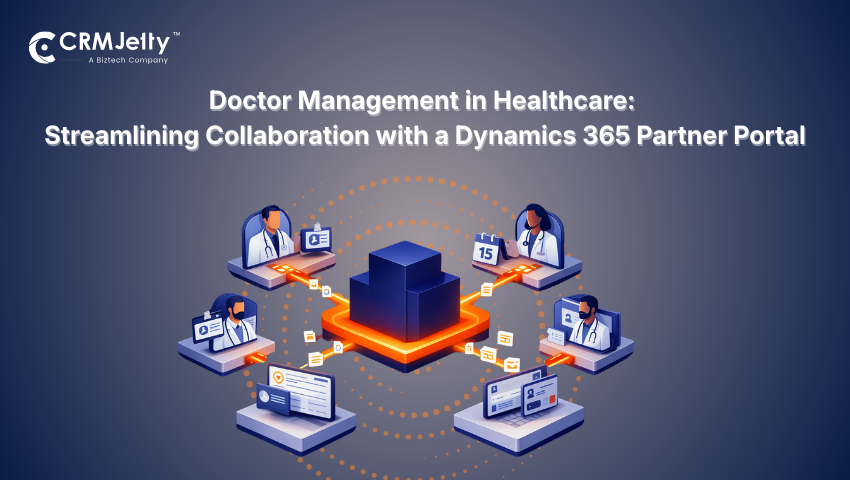

Most healthcare organizations are not “behind” when it comes to systems. Hospitals, multi-specialty clinics, and healthcare networks have already invested heavily in Microsoft Dynamics 365. Patient data, referrals, contracts, compliance records, and operational workflows are all housed in the CRM. Leadership dashboards exist. Reporting exists. Governance exists.
And yet, when it comes to doctor management, many teams quietly admit something feels off.
The issue isn’t that information is missing. It’s that doctors operate just outside the system that’s supposed to support them.
Today’s doctors are rarely confined to a single location. Visiting specialists, consulting physicians, rotating surgeons, and multi-hospital practitioners are now the norm. Microsoft Dynamics 365 stores these records internally. However, many day-to-day interactions—availability updates, credential renewals, referrals, and administrative requests—still occur via email, shared drives, and informal follow-ups.
Over time, a parallel operating layer forms:
- Emails become the real coordination tool, not the CRM.
- Credentials exist in Dynamics, but renewals depend on reminders and memory.
- Scheduling data is technically centralized, but practically outdated.
- Communication spreads across departments with no shared operational context.
This disconnect shows up where it hurts most:
- Doctors aren’t assigned on time because availability isn’t trusted.
- Compliance teams scramble to address expired documentation before audits.
- Admin staff spend hours chasing routine updates.
- Doctors lose patience with repetitive, manual processes.
Industry research, administrative complexity now accounts for over 40% of total hospital operating costs, much of it tied to coordination and compliance overhead. A lack of systems doesn’t drive that cost—it’s driven by poor connection between systems and external stakeholders.
Doctors, like everyone else, expect clarity and autonomy: secure self-service, fewer interruptions, and one place to interact with the organization.
This is where a Dynamics 365 partner portal becomes more than just a tool. It becomes the missing connective layer of a healthcare portal, bringing doctors directly into Dynamics 365 workflows—without compromising security, governance, or compliance.
Use Case Scenarios: Where a Doctor Portal Changes the Game
Let’s move from theory to practice. Here’s how a well-implemented partner portal solves real operational challenges that healthcare organizations face every day.
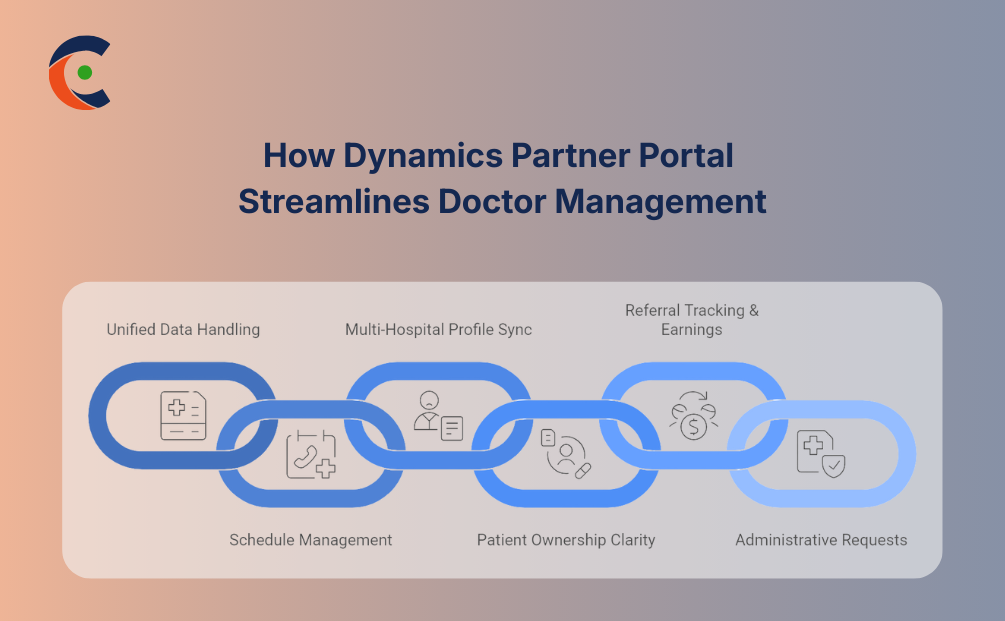
Use Case 1: Unified Doctor Identity, Credentials, and Compliance Management
Problem
Credential management is rarely broken—it’s just fragile. Licenses, certifications, insurance documents, and contracts are stored in Dynamics 365, but the upkeep relies on manual nudges. One missed renewal can delay assignments or trigger compliance exposure during audits.
Solution
CRMJetty Dynamics 365 partner portal centralizes doctor identity and compliance into a single, authoritative record. Doctors access a secure portal to upload documents, respond to renewal requests, and track approval status. Validation rules and reminders live inside Dynamics, not inboxes.
Outcome
- You finally have one version of the truth: Instead of wondering whether the credential file in Dynamics 365 matches what’s actually current, you know it does. Every doctor’s license, certification, and insurance document is stored in a single record. Same status everywhere. Your credentialing team, compliance officers, and department heads all see the same information—because there’s only one version.
- Audits stop being panic sessions: When regulatory auditors show up (or when you’re preparing submissions), you’re not frantically pulling reports and hoping the data’s current. Compliance teams generate what they need instantly, and the data’s actually up to date because doctors maintain it in real time.
- New doctors hit the ground running: Before, onboarding took forever because you had to chase down documentation for weeks. Now, new physicians upload everything before their start date even arrives. What used to stretch across 90-120 days gets compressed significantly—in many cases, cut by a third or more—because you’re not stuck in document collection limbo.
Use Case 2: Doctor Scheduling and Availability Management
Problem
Scheduling breaks down when availability is assumed rather than confirmed. Manual updates lead to uneven workloads, last-minute reshuffles, and frustrated clinicians. Over time, trust in the schedule erodes.
Solution
Through the CRMJetty Dynamics self-service portal, doctors manage availability directly. Updates sync in real time with Dynamics 365, giving administrators a planning view they can actually rely on. Adjustments happen faster, with fewer surprises.
Outcome
- Workload actually balances out: When you can see real availability data, you stop accidentally overloading two doctors while keeping others’ schedules half-empty. The chronic over-scheduling and under-utilization patterns that plague most facilities are starting to even out because administrators are making decisions based on what doctors actually have bandwidth for, not guesswork.
- The emergency reshuffle rate drops hard: You know those frantic 4 pm calls when someone discovers a conflict and the whole next day’s schedule implodes? Those happen way less often. Real-time updates mean conflicts surface early enough to fix them properly, rather than triggering cascading emergencies across multiple departments.
- Doctors stop resenting the schedule: There’s something deeply frustrating about having your time managed by someone else with incomplete information. When physicians control their own availability and see their commitments clearly laid out, satisfaction scores go up. They’re not being passively assigned anymore—they’re actively participating in how their time gets used.
Use Case 3: Unified Doctor Profile Across Multiple Hospitals
Problem
Doctors affiliated with multiple facilities often exist as multiple records. Updates happen inconsistently. Departments reference different versions of the same profile, creating coordination issues that surface at the worst possible time.
Solution
CRMJetty Dynamics 365 partner portal maintains a single doctor profile linked across hospitals, departments, and contracts. Doctors update their information once on the portal. Dynamics reflects it everywhere it’s needed.
Outcome
- Nobody’s playing detective anymore: Before, someone needed to track down which facility had a doctor’s current contact info. Was it Regional with the old address? City Medical with the updated cell? Community Care with who knows what? That detective work just stops. There’s one profile. It’s current everywhere.
- The duplicate data nightmare ends: Think about how much time gets wasted syncing information manually across systems. When a doctor updates their practice insurance, your team must notify three facilities of the change. With a unified profile, one update propagates everywhere automatically. Your staff no longer has to relay updates manually between systems.
- Cross-facility coordination actually works: When a doctor’s status changes—say, they add a new specialty certification or their privileges get modified—all affiliated organizations know immediately. No lag time. No information asymmetry. No “oh, we didn’t know that” moments when you’re trying to coordinate urgent cases across facilities.
Use Case 4: Doctor–Patient Relationship Management (Owned vs. Referred Patients)
Problem
When patient ownership isn’t clearly defined, follow-ups slip through the cracks. Teams don’t always know who is accountable—especially in referral-heavy environments.
Solution
The CRMJetty partner portal surfaces structured patient relationships defined in Microsoft Dynamics 365. Doctors can see which patients they own versus those they’ve referred, along with status and subsequent actions, without overexposing themselves to sensitive data.
Outcome
- The “whose patient is this anyway?” question disappears: You know those awkward moments when a patient needs follow-up, and nobody’s quite sure whether it should go to the referring physician or the specialist? Those conversations just stop happening. The system makes it crystal clear who owns each patient relationship at every stage, so there’s zero ambiguity about who needs to do what.
- Referrals actually close the loop: Referring doctors can finally track whether their referrals were completed or fell through. Before, a doctor would refer someone and then just… wonder whether the other doctor had seen the patient or whether the procedure had happened? Now they know, which means they can follow up appropriately with their patient instead of operating blindly.
- Patients stop falling into gaps: You know what’s scary? Patients are slipping between providers because no one is quite sure who’s responsible for the next step. Structured handoffs with visible accountability mean continuity of care actually happens. When care transitions back from a specialist to a primary physician, everyone involved can see it happen rather than assume someone else is handling it.
Use Case 5: Cross-Hospital Referral and Earning Transparency
Problem
Referral tracking often relies on manual reconciliation. Doctors lack visibility into referral progress or associated earnings, leading to disputes and delayed settlements.
Solution
The CRMJetty partner portal provides end-to-end visibility into referrals. Doctors track referral status and view earning summaries based on rules configured in Microsoft Dynamics 365—no spreadsheets, no ambiguity.
Outcome
- Referrals become trackable: Dr. Lee can finally see what happened with every patient she referred out. Did the cardiologist at Facility A see them? Was the procedure completed or rescheduled? Is it still pending? Before this was a black box—refer and hope. Now it’s visible from start to finish, which means she can follow up intelligently with her patients.
- Earning calculations stop being mysterious: You know what breeds distrust fast? When doctors have no idea how their referral-based compensation is calculated. The CRMJetty portal shows exactly what they’ve earned under which rules, backed by actual procedure data from Dynamics 365. Everything’s transparent and auditable, so there’s no “trust us, the number’s right” happening.
- Quarterly reconciliation headaches just vanish: Those nightmare sessions where someone’s comparing spreadsheets, trying to figure out missed referrals or miscalculated amounts? Largely gone. When data flows in real time and calculations happen automatically in Dynamics 365, there’s nothing to reconcile manually. Disputes drop dramatically because everyone’s looking at the same transparent information.
Use Case 6: Doctor Administrative Self-Service Requests
Problem
Administrative teams are overloaded by routine requests—profile changes, document submissions, and access updates. Each email adds friction.
Solution
The CRMJetty partner portal enables structured self-service requests. Doctors submit, track, and resolve requests via workflows directly connected to Dynamics 365.
Outcome
- Your admin team stops drowning in trivial stuff: When doctors can update their own phone numbers, upload new profile photos, and request access changes through self-service, your administrative staff gets their lives back. Those hundreds of routine emails per month? Most of them just disappear because doctors solve their own problems. Your team shifts from being reactive ticket-takers to handling actually complex exceptions.
- Request turnaround speeds up dramatically: Before, a simple change might take two days because it sat in someone’s inbox waiting for them to get around to it. Now? Simple updates happen instantly—the system applies them and logs for audit. More complex requests flow through automated workflows to the right approver. Either way, doctors aren’t stuck waiting for someone to manually process their stuff.
- Doctor experience improves noticeably: There’s something satisfying about fixing your own problems immediately, rather than emailing someone and hoping they respond. Doctors appreciate the autonomy. They appreciate the transparency of being able to see the request status. And they definitely appreciate not having to explain the same thing three times to different people.
What CRMJetty Enables Behind the Scenes
Technology is only valid when it fits how people actually work. That’s the philosophy behind CRMJetty’s Dynamics 365 partner portal.
This isn’t a one-size-fits-all template. It’s a framework built for objective healthcare complexity—designed to bend and adapt to your organization’s specific workflows, compliance requirements, and operational realities.
Here’s what CRMJetty’s portal can handle:
-
Doctor-specific workflows with built-in governance
Configure approval chains for credential submissions, schedule change requests, or profile updates. Route requests to the right people automatically based on doctor role, hospital affiliation, or department.
-
Credential rules are tied directly to regulatory and internal policies
Set validation logic that matches your compliance requirements—automatic expiration alerts, mandatory document types by specialty, and approval workflows for high-risk credentials.
-
Role-based access aligned with Dynamics 365 security roles
Doctors see only what they need to see. Administrators control who can view, edit, or approve specific data. Security policies cascade from Dynamics, so there’s no separate permission system to manage.
-
A branded, scalable portal experience
The portal reflects your organization’s identity—its logo, colors, and terminology. As your doctor network grows, the portal scales seamlessly without requiring architectural changes.
Here’s what matters most: everything stays Dynamics-native. The portal doesn’t duplicate data or create parallel systems. It’s an extension of Dynamics 365—just made accessible to people who need it outside your organization’s walls.
Business Impact for Healthcare Leadership
When doctor collaboration moves from scattered email threads into a structured partner portal, the impact isn’t just incremental—it’s compound.
Administrative costs drop measurably
CRMJetty Dynamics 365 self-service portal eliminates hundreds of hours of manual follow-up each year. Your credential specialists stop chasing renewals and start focusing on exceptions and complex cases. Schedulers work with trusted data instead of playing phone tag. Administrative teams get their time back to focus on higher-value work.
Doctor onboarding and ongoing coordination accelerate
New physicians submit credentials before their start date. Renewals happen proactively—schedule updates sync in real time. What used to take weeks now takes days. What used to require constant manual intervention now runs on autopilot.
Your compliance posture strengthens
Real-time visibility into credential status means you catch expirations before they become problems. Audit reports are generated instantly. Regulatory submissions are based on accurate, current data. You shift from reactive scrambling to proactive management.
Doctors stay engaged because the system respects their time
They’re not filling out the same forms repeatedly. They’re not waiting days for simple updates. They’re not wondering where their requests went. They have autonomy, transparency, and control. That matters for retention and satisfaction.
The Future of Doctor Management Is Connected
Doctor management isn’t just an operational task anymore. It’s a strategic capability.
Healthcare organizations that digitize doctor collaboration—that extend their Dynamics 365 infrastructure outward in secure, intentional ways—gain efficiency, yes. But they also gain transparency, scalability, and resilience.
They build systems that work with their doctors, not around them. They build infrastructure that supports growth rather than creaks under it. They position themselves to adapt as healthcare delivery models continue to evolve.
Ready to modernize doctor management without disrupting your Dynamics foundation?
All product and company names are trademarks™, registered® or copyright© trademarks of their respective holders. Use of them does not imply any affiliation with or endorsement by them.